-

The elimination of Aboriginal languages and the legacy of colonisation
‘2019 is the International Year of Indigenous Languages. But the state of Australia’s Indigenous languages is not good. Of the 250 or so languages spoken here when colonisation began, less than half are still spoken. Only 13 could be considered “strong” ― that is, they are still being spoken by children. Throughout history, languages have always risen to prominence or faded away as people groups move and grow. Some might ask, then, why worry about the relative strength or even the passing of Indigenous languages?’
-
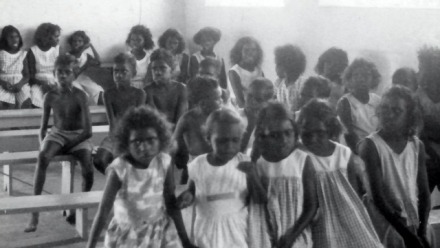
Why do so few Aussies speak an Australian language?
‘Linguistically speaking, Australia is special. With around 250 languages spoken when Australia was first colonised, Australia was one of the most linguistically diverse places in the world.
But few people speak our Indigenous languages. As of 2016, only 10% of Australia’s Indigenous population spoke an Indigenous language at home. Most Indigenous languages are now “asleep”, waiting to be woken up by language revivalists.
Australian languages did not simply fade away; they were actively silenced by governments, schools and missions.’
-
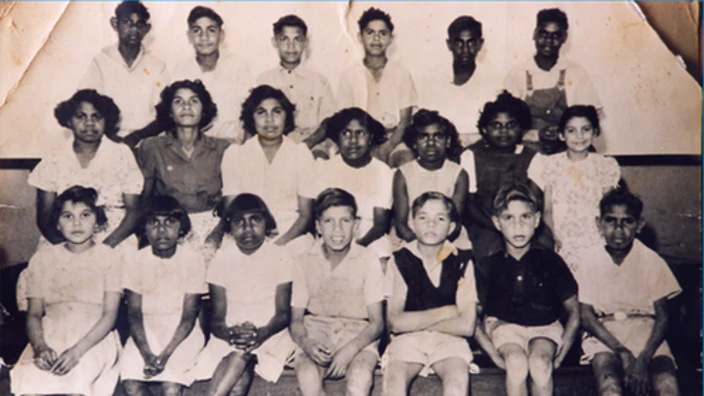
Aileen Marwung Walsh in The Conversation – Friday essay: back to Moore River and finding family
The settlement was established in 1918 as a solution to the Aboriginal problem, as perceived by colonists. There were too many Aboriginal people “wandering about” WA, usually on reserves near ration depots where they received flour and blankets. The colonists did not want to see them.
Plus A.O. Neville, the Chief Protector of Aborigines, had a plan to breed out the black of the Aborigines so they would not be Aboriginal anymore. The full bloods would die out and the half castes would blend in. Neville laid out clearly how he would do this in his book Australia’s Coloured Minority.”
View the full article published in The Conversation and republished on SBS NITV.
-
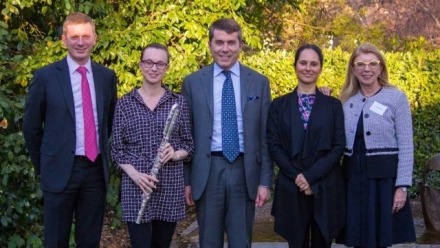
ARC research on the deep human past inspires a musical response
“In 2018, ARC Kathleen Fitzpatrick Laureate Fellow, Professor Ann McGrath, a historian at The Australian National University (ANU), was contacted by the New York-based composer, Dr Andreia Pinto Correia, to initiate a creative collaboration that would unite their two worlds, and celebrate the ancient landscapes of Australia with a new musical composition.
The idea of a creative collaboration was sparked in 2014, when Dr Correia and Professor McGrath met and shared ideas during their month-long residencies at the Rockefeller Centre, Bellagio—a foundation that serves to bring scholars and artists together for creative exchanges that aim towards human advancement—situated on the shores of the idyllic Lake Como, in northern Italy.
In her compositions, Dr Correia draws upon her Portuguese heritage, deep knowledge of its folk traditions and historic places, and her insights into European literature, intellectual traditions and languages. Dr Correia has composed unique pieces for leading orchestras, ensembles and solo artists internationally, including a symphony performed at the Tanglewood Music Centre, major pieces for the Boston Symphony orchestra and other orchestras around the world.”
-
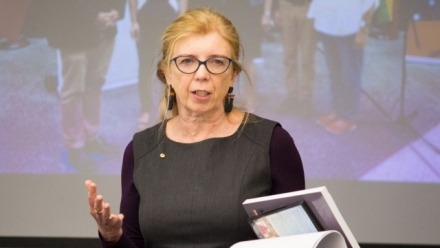
Researchers join at ANU to explore ways of viewing the past
Speakers from around Australia and the world have recently come together at ANU for the Deep Human Past’s Inaugural International Symposium.
The symposium was convened by Professor Ann McGrath and Dr Laura Rademaker from ANU School of History, and ANU alumna Professor Jaky Troy, Director of Aboriginal and Torres Strait Islander Research at University of Sydney. Professor McGrath and Dr Rademaker are part of the ARC Laureate Program for the Deep Human Past at ANU, an ambitious project aiming to change the way we understand pre-colonial history of Australia and beyond.
Bringing together talents from across a variety of disciplines including history, linguistics, the arts, anthropology and philosophy as well as experienced Indigenous practitioners, the symposium explored the various ways history is conceived and recorded.
The symposium was opened by Professor Richard Baker, Pro Vice-Chancellor (University Experience), and Tyronne Bell, who offered the Welcome to Country.
Professor Jacky Troy delivered a keynote, offering a personal perspective on Indigenous exploration of place and time.
Dr Catherine Frieman from ANU School of Archaeology and Anthropology delivered a presentation on the temporality of archaeological narratives, while Dr Rademaker touched on themes in her new book Found in Translation looking at Aboriginal and missionary conventions.
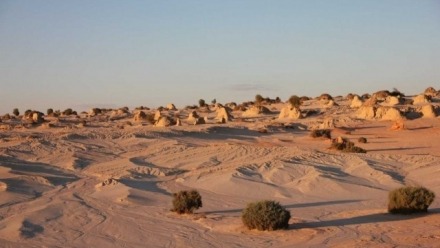
The symposium also heralded a unique collaboration between the research schools of the ANU College of Arts and Social Sciences, with leading international composer Andreia Pinto Correia appointed a joint visitor. Based in the ANU School of Music, where she shared her professional insights with students, Andreia composed an original flute piece entitled Pleistocene Landscapes in honour of Professor McGrath’s work. The piece interpreted the changing sands of time with a particular emphasis on the Lake Mungo region. Inspired by a place Andreia had then seen only in the film Message from Mungo proved a creative challenge for the experienced composer. But embracing the challenges, she produced a unique piece, making creative use of extended technique on the flute, to produce sounds and rhythms evocative of wind, and the movement of the grains of sand, to evoke a place of deep history and a long civilization.
In its stunning world premiere, Pleistocene landscapes was performed on alto-flute by Canberra musician Kiri Sollis, of the Griffyn Ensemble.
-
Postdoctoral Research Fellow position available
The Research School of Social Sciences (RSSS) at ANU provides a dynamic research environment; it undertakes research and education across several disciplines to the highest international levels. The School of History is seeking a highly capable and self-motivated Postdoctoral Research Fellow to work on the 2017 Kathleen Fitzpatrick Australian Laureate Fellowship for research on ‘Rediscovering the Deep Human Past: Global Networks, Future Opportunities’. This project will launch an innovative research initiative, The Deep History Research Centre, an Australian-based international consortium in partnership with Harvard and Cambridge centres, which will make a significant impact on global scholarship. The appointee will be located in the School of History within RSSS.
The full description, requirements, and application can be found on the original position listing.
-
Workshop on Indigenous Histories
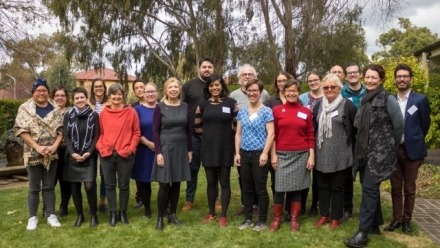
Developing new methodologies for researching and recounting histories that reckon with the long duration of Indigenous life on, in, and of this land is at the heart of the ARC Laureate Project Rediscovering the Deep Human Past. The field of Indigenous histories has long been at the forefront of disciplinary shifts and challenges, both through embracing diverse archives and appreciating them from and in relation to Indigenous perspectives, of overturning older understandings of history. These practices have produced rich possibilities for historical transformation. From commitments to decolonisation, to practicing history in the field, to engaging seriously with Indigenous knowledges, the field has been characterised by multidisciplinary research practice which, at its best, engages creatively without appropriating unquestionable authority over Indigenous pasts.
We facilitated the first Kathleen Fitzpatrick Workshop of the ARC Laureate Program, at University House at the ANU on 26 September, to provide an opportunity to think about and work on some of these new methodologies in Indigenous histories. We brought together some established researchers with about twenty promising early career scholars who are doing innovative work in Indigenous histories; some working with a long duration, some with unconventional sources, some with unexpected connections and places. After welcomes and introductions from Professor Ann McGrath and Dr Ben Silverstein, we discussed methodological possibilities, as well problems and blockages, in new research being carried out across the field.
Ann McGrath introduced the problem of carrying out research into deep time history, inviting the delegates to be part of the journey into new research methods that were collaborative, risky, transdisciplinary, and multivocal, and which seek urgently to widen the scale and scope of Australian history. Dr Laurie Bamblett led a discussion on methods of questioning and learning in Aboriginal communities, considering ways of approaching people ethically and responsibly, and of carrying out research that was faithful to their expectations and understandings. Dr Maria Nugent turned our attention from the process of gathering stories to that of working with them, engaging the difficult responsibilities of the historian in engaging with archives and oral histories. And finally, Professor Jaky Troy discussed the ways of working with archives in projects of language revival and resurgence, along with Mujahid Torwali who spoke on his work revitalising the Torwali language of Pakistan.
In the concluding discussion we returned to the problems of searching for, and our responsibility to, truth. This was a question that had recurred throughout the day, along with the matter of how historians might engage with the varied histories and history-making practices of Aboriginal people that often challenge the way the disciplines have represented the Australian past. These questions remain unresolved, providing us with much to consider and work on over the life of the Laureate project. We’re looking forward to further collaborations with the many talented researchers who attended the day.
-
New book ‘Found in Translation’ launched at ANU
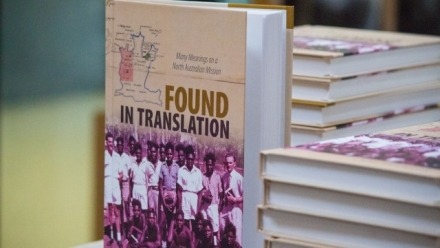
ANU Vice-Chancellor Professor Brian Schmidt, and University Council Member Mr Peter Yu, have launched Found in Translation, the new book from historian Dr Laura Rademaker.
Dr Rademaker, a researcher in the ANU School of History and part of the Rediscovering the Deep Human Past Project, explores in the book language and cultural interactions between Christian missions and Indigenous Australians.
Her book focuses on the experiences of the Aboriginal community of Groote Eylandt, from the establishment of the Angurugu Mission in 1943. Through innovative research and remarkable engagement with local communities, she has produced an account of cultures persevering and cultures colliding.
Speaking at the launch Mr Yu, a Yawuru Man from Broome in the Kimberley with over 35 years of experience in Indigenous development and advocacy, described the book as “mandatory reading.”
Vice-Chancellor Brian Schmidt praised the book for exemplifying the Australian National University’s deep commitment to Indigenous issues and community engagement.
Dr Rademaker has more recently been working on the Deep Human Past project, a new initiative in the ANU School of History aiming to explore Aboriginal narratives, and bringing new and deeper understanding to Australia’s pre-1788 history. She is also conducting research for a future book looking at Aboriginal experiences in the Tiwi Islands.
Dr Rademaker studied History at ANU, completed her Bachelor of Philosophy with 1st Class Honours and the University Medal for History. She subsequently completed her PhD at ANU, and was awarded the 2014 J.G. Crawford Medal for her Thesis ‘Language and Translation.’
Found in Translation is available now and is published by University of Hawaii Press.
-
Deep Human History Laureate PhD Scholarship
The School of History in the ANU College of Arts and Social Sciences offers two scholarships known as the Deep Human History Laureate PhD Scholarship, to support students while they undertake a PhD in Indigenous Australian history at the Australian National University.
The scholarships are associated with the Rediscovering the Deep Human Past Laureate Program. This research project explores Aboriginal narratives in order to develop a deeper understanding of Australia’s pre-1788 history. In order to achieve our research aims, our project methodology will involve holding community workshops, repatriating important stories, and undertaking individual oral history interviews with participants.
Postgraduate students will concentrate on a particular regional Focus Area and will address the recuperation of knowledge from linguistic and museum collections and undertake reconnection and repatriation with custodians in connected landscapes. Focus Area research and Symposium development will be matched to the particular areas of expertise, interest and networks of the recruit.
Futher information is available on the application page.
-

Rediscovering the Deep Human Past: Global Networks, Future Opportunities
Speakers
Professor Jaky Troy
Professor Ann McGrath
Dr Maria NugentThis one-day workshop will run in conjunction with the two-day symposium on ‘Understanding the deep past across language and culture’ on 27–8 September.
The field of Indigenous histories has long been at the forefront of disciplinary shifts and challenges. An active embrace of diverse archives and an openness to Indigenous methodologies has produced rich possibilities for historical transformation. Whether characterised by a commitment to decolonisation, to engaging seriously with Indigenous knowledges, or by practicing history in the field, research in Indigenous histories has been characterised by multidisciplinary research practice. This workshop will present an opportunity to discuss new work and future directions in the field.
Further information: https://history.cass.anu.edu.au/sites/default/files/docs/2018/10/CASS181948_ECR_Workshop_flyer_v1.pdf

Publications


All rights reserved ® Research Centre for Deep History, The School of History, The Australian National University | Built by Tabs.